Successful financial leadership depends on clear, consistent, and proactive communication with the community. School district finances are complex, and school leaders must tell the story behind the data and explain financial decisions to ensure that stakeholders understand both challenges and opportunities.
Effective communication begins long before a levy request or financial challenge arises. Regular board updates, public meetings, financial reports, podcasts, videos, brochures, websites, and social media outreach are all opportunities for creating regular dialogue with communities. This enables community members to become informed partners rather than occasional observers.
The Fiscal Committee Approach
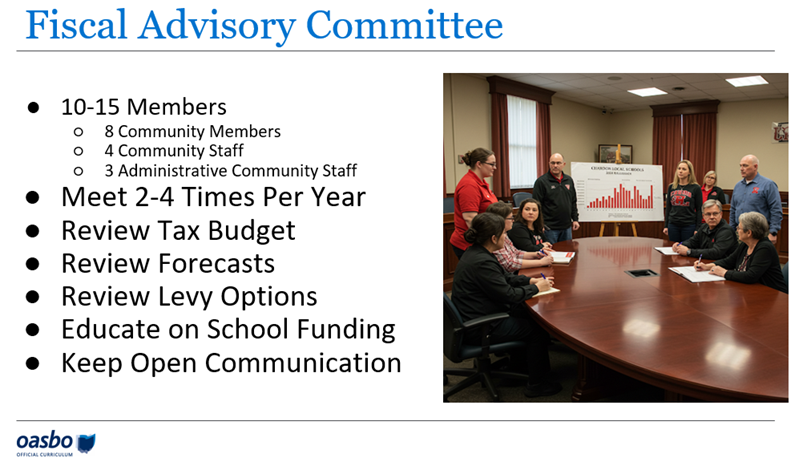
A valuable approach is establishing or maintaining a Fiscal Advisory or Finance Committee made up of community members, staff, and administrators. By meeting regularly to review tax budgets, financial forecasts, funding options, and school finance issues, the committee serves as a bridge between the district and the public. This approach reinforces transparency and allows community members to understand financial decisions. Most importantly, it encourages continuous dialogue, not just crisis-driven communication.
Chardon Local Schools’ Fiscal Advisory Committee had a significant impact recently when county commissioners were considering the piggyback homestead exemption that would result in financial losses to all county school districts, townships, municipalities, and special districts. After reviewing the potential financial impacts, committee members worked together to create a petition for all Geauga County Schools that explained the potential loss. They also collaborated with other public agencies that would be impacted to generate social media content as well as letters and emails to county commissioners. As a result, the commissioners did not vote for the piggyback exemption. Informed communities are empowered communities.
The Importance of Transparency
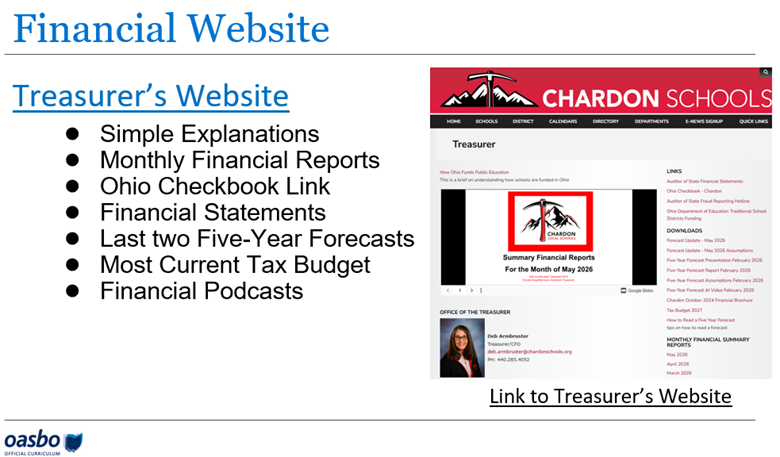
Transparency is key to community engagement and partnership. Tools such as BoardDocs, which make meeting materials publicly available, along with monthly financial reports, contracts, meeting videos, brochures and the Ohio Checkbook provide stakeholders with direct access to district information. Transparency reduces confusion and strengthens trust.
The Treasurer’s Webpage on the district site is a key place to keep resources, including simple explanations, reports, forecasts, the tax budget and other financial resources.
Keep it Simple for Success
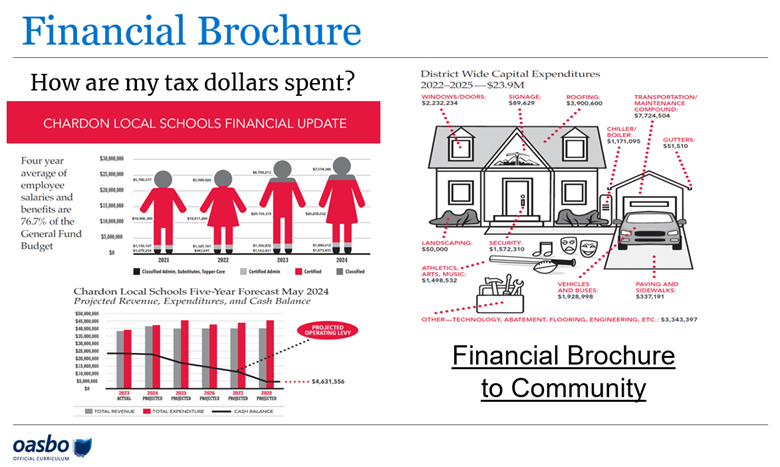
It is important to prioritize transparency, but it’s equally important to keep it simple. Financial forecasts, tax budgets, and reports are often filled with technical terminology and complex data that could be confusing to staff and community members alike. Take time to break this down into simple charts and facts by asking simple questions such as “Where does our district get its funding?” “How Does Our District Spend its Money?” “Why are expenses changing?” and “When and why is a levy being considered?” Providing simple explanations to these questions that stakeholders can comprehend and support builds knowledge and engagement.
Another approach to simple communication is storytelling. Rather than showing trends only using spreadsheets, your district can tell its story through simple comparison graphs that show enrollment trends, staffing adjustments, and specific funding such as athletics. Comparing revenues, expenditures, salaries, benefits, and growth rates with similar districts can be a valuable part of storytelling as well. These comparisons help stakeholders understand how the district is performing and whether financial practices align with peer districts.
In conclusion, it’s time to “Set the Record Straight” with strong communication that fosters understanding, confidence, trust, and better financial leadership. Financial leadership is about more than predicting revenues and expenses; it’s also about building relationships through continuous communication. Districts that communicate clearly and transparently create informed communities who are prepared to support critical decisions. In today's landscape, trust is a district’s most valuable asset, and consistent communication is essential to earning and maintaining it.
This article was based on a module of the Essentials of Budgeting and Forecasting. You can watch the module here. You can view the PowerPoint from it here.